
The 9 Box Grid method is an innovative approach to managing organizational development that helps group employees based on their potential and performance. It is based on a visual tool that can be easily adapted to the needs of your company. It allows you to visualize employees in nine intersecting fields, which is why it is called the “9-box grid.”
The potential dimension of the assessment focuses on the employee’s abilities, skills, and potential for development. It assesses what development opportunities a given employee has, whether they are ready for promotion, and whether they have the ability to take on more responsible positions in the future.
The performance dimension focuses on employees’ achievements in their work to date. The performance assessment takes into account how well the employee performs their duties, what goals they have achieved, what results they have achieved, and what their contribution to the organization’s activities is.
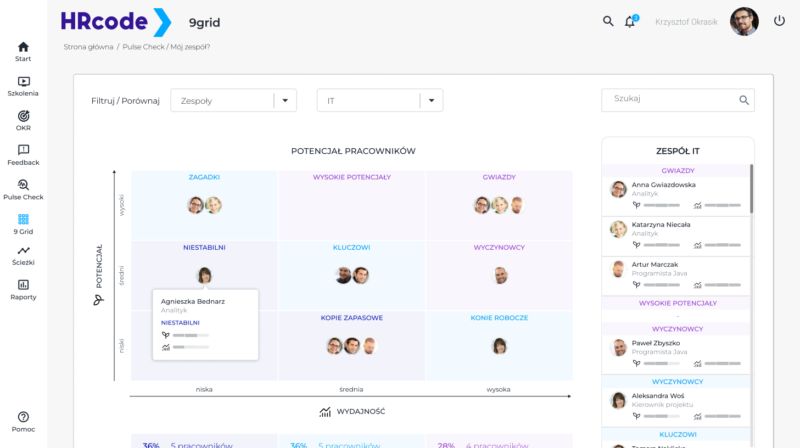
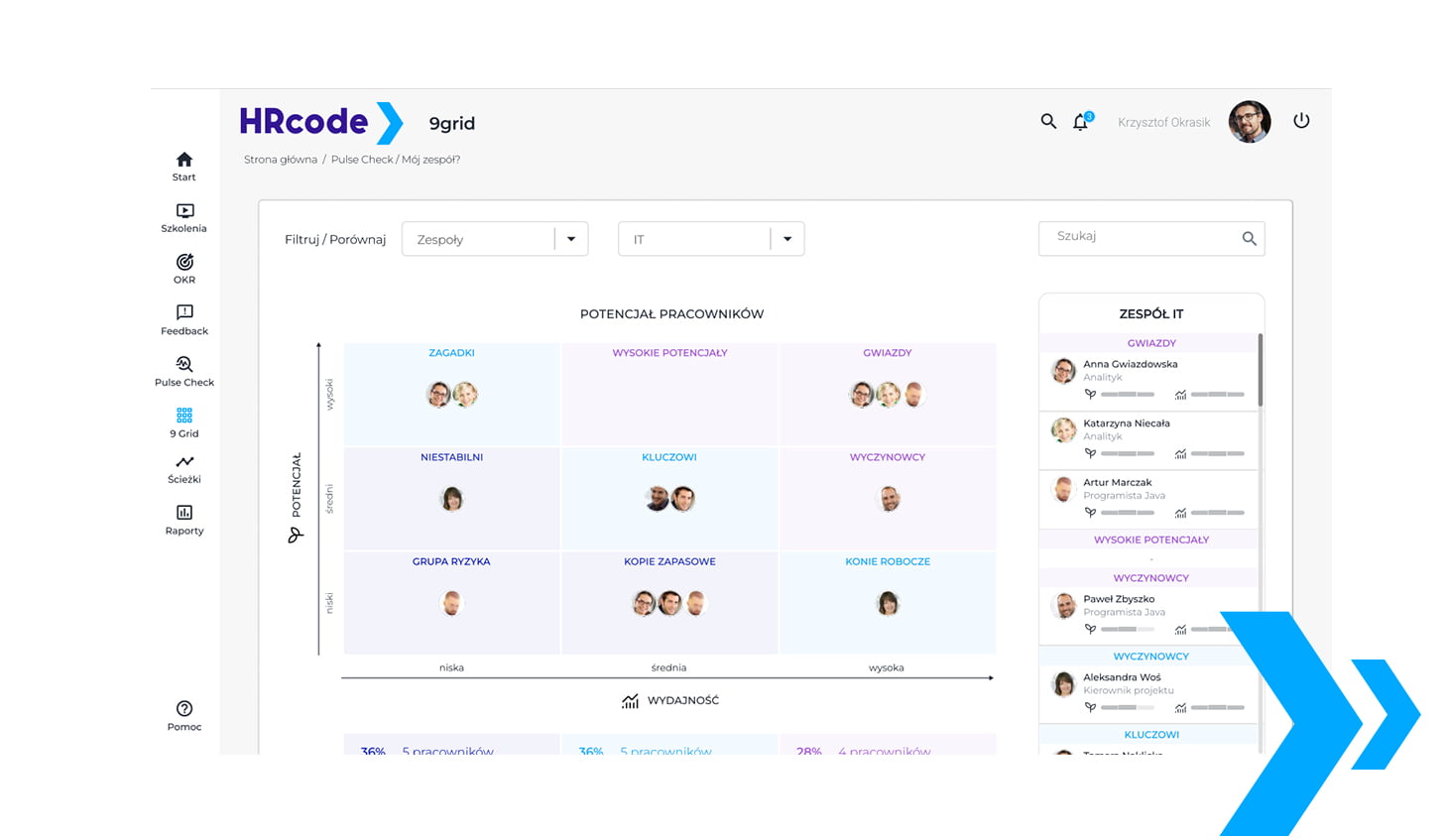
The 9 Grid Matrix method is:
- Objective assessment: The 9 Grid method can help avoid subjectivity in employee assessment because it is based on a specific analysis of performance and potential criteria.
- Identification of strengths: It helps identify high-performing employees, which can be crucial in understanding who contributes most to the success of the organization.
- Development of potential: This method can be used to identify employees with high potential who may not yet be reaching their full potential. This provides an opportunity to focus additional attention and development on them.
- Human resource management: It helps HR departments identify employees who may be potential leaders or who need individual support. The tool is a matrix in which employee potential and performance are placed, which helps to efficiently manage human resources and the organization.
If you are looking for an effective strategy to manage your company’s growth and assess your employees’ potential, the 9 Grid method may prove to be an excellent tool. It increases efficiency, helps achieve goals, and provides a clear direction for action. For more detailed information on this topic, please contact us.
Are you fully aware of the competency resources in your company? The 9 grid box will help you discover them. This tool, also known as the nine box model, 9 box talent matrix, or simply the nine box, is used for talent management in organizations. It serves to analyze, present, and compare employee performance levels and identify their potential.
This easy-to-use matrix helps HR departments and managers effectively manage human resources and strategically prepare employees for future roles.
What is a 9-box matrix?
A 9-box matrix is a grid of nine fields arranged in a three-by-three pattern. It is interpreted as follows:
- The vertical dimension assesses employees’ potential for development, which is classified as low, medium, or high. These levels correspond to the employee’s ability to develop and advance to higher positions within the company.
- On the horizontal axis of the matrix, the current performance of employees is assessed, also divided into three categories: below expectations, in line with expectations, and exceeding expectations.

This tool is used for both performance management and talent mapping. It allows you to visualize an employee’s current performance and shows their development potential.
The 9-box model helps HR departments proactively prepare for inevitable personnel changes. It is a financially optimal, simple method that allows you to:
- identifying internal leaders,
- assessing talent distribution,
- succession planning,
- identifying problems,
- noticing gaps in the skill pool.
This model is not just another HR tool; it is a strategic asset and a competitive advantage in talent management. Potential assessment is also a good complement to the periodic evaluation process.
What actions does the 9-box model enable?
How will the 9 Box Talent Matrix change your work? First and foremost, it will make it easier for you to analyze the effectiveness and development potential of your teams. And as we mentioned, data is the starting point for making informed HR decisions. Using the 9 Box matrix will enable you to, among other things:
- monitoring the progress of employees who do not perform as well as others – they have average performance and limited potential. By using this tool, you will be able to objectively assess progress or lack thereof, and develop a strategy for developing low-potential individuals.
- promoting the most effective employees who show great potential for development. The Nine Grid Box will allow you to effectively identify talent and create a HiPo (High Potential Employee) database, making succession planning much easier. And as a result…
- …you will be able to effectively and proactively prepare high-potential employees to take on management positions.
How to create a 9-box grid potential assessment?
The 9-box model is a tool used to analyze, present, and compare employee performance and potential. To create such a matrix, follow these steps:

Assessment of current performance – employees are evaluated based on their current productivity. The assessment criteria include aspects such as: quality of work performed, achievement of set goals, cooperation skills, and other indicators relevant to the company’s operations.
Assessment of development potential – this step focuses on the employee’s opportunities to develop their expertise and leadership skills. It is important to consider their ability to cope with difficult situations, their capacity to acquire new skills, and their chances for future promotion.
Mapping in the 9 Box Matrix – after assessing performance and potential, employees’ names are placed in the appropriate section of the nine-box matrix.
Action planning – based on employees’ positions in the 9 Box matrix, managers and L&D specialists can develop appropriate actions, such as training programs, development paths, promotions, or adaptations to new roles, if necessary.
Development and progress tracking – once the planned activities have been implemented, it is important to track employee progress and adjust it to the needs of the organization, regularly updating their positions in the matrix.
Challenges and pitfalls – what to watch out for when implementing the 9 Box matrix?
You probably know very well that it is very important for HR professionals to be aware of their own, often unconscious biases (this is a cultural burden that almost all of us carry. The simplest test is to imagine a person crying at work – most people imagine a woman, which highlights a certain stereotype). If you decide to use the 9-box model, more than one person should be involved in the assessment. This is a safeguard against a situation where the evaluator’s unconscious biases distort the results of the assessment, especially when evaluating soft skills. Training managers will ensure consistent and reliable application of the model.
At the beginning, it is worth taking the time to consider how to define the criteria for assessing potential so that they yield valuable data. Establishing clear and objective criteria will help avoid inconsistencies and unequal treatment.
In addition, the 9-box matrix should be updated regularly. This will allow you to assess how the situation of employees has changed over time. Remember that the situation of employees changes over time, so assessments must be reviewed regularly.
Advantages of the 9 Box matrix from HRcode
Now that you know how to design the process, it is worth highlighting the benefits of using the nine-box grid to explore the potential within your organization. HRcode helps you create an easy and transparent matrix model.

The nine-field matrix is intuitive to understand and use. Each field in the grid has pre-assigned values, so you can see the whole picture at a glance. It’s like a dashboard for your organization’s potential.
Facilitating strategic decision-making. Beyond its basic application for assessing performance and potential, the 9-box talent matrix tool can be used for leadership development and succession planning.


Integration with the platform’s functionalities will allow you to use your knowledge to manage other processes, such as training planning, career paths, and promotions. You will find everything in one integrated environment.
Better data-driven business decisions. A holistic view of your company’s competency resources enables you to make better long-term business decisions.


Effective budget management. Awareness of competency gaps or succession opportunities allows for better planning of financial resources allocated to training.
Better identification of talent and high-potential employees. The model makes it easier to spot individuals who demonstrate high performance and significant development potential.


More effective career path planning. By assigning employees to the 9 Box Talent Matrix, it is easier to determine which of them should be included in development programs.
Optimization of investments in training and development. Mapping competencies combined with development plans allows you to assess what gaps in the necessary skills may occur in the future. This allows you to plan appropriate training in advance.


Increased commitment and motivation – teams see opportunities for promotion and gaining additional knowledge within the company, which translates into higher commitment and motivation. No more changing jobs due to a “lack of development opportunities”!
Improved retention of key talent, as effective talent management enables the organization to retain its most valuable employees.

It is difficult to ignore these advantages. They make the 9 box grid a strategic tool that provides the most important knowledge for making key business decisions.
Best practices for implementing the 9 Box Grid

What practices are worth knowing when preparing to implement the 9-Grid model in your company? One of the most important things is to involve key stakeholders from the very beginning of the process. Their voice in the discussion will help develop criteria appropriate to the situation in the company, and appropriate training will enable the assessment process to be carried out efficiently.
The established criteria must be precisely defined, understandable, and accepted by all participants in the assessment, and the entire process must be conducted in accordance with the principles of equal treatment. Remember that being assessed can be stressful for employees, so it is worth explaining to them what the individual stages will look like.
It is extremely important to conduct evaluations using the 9 Grid method on a regular basis. The results of the evaluation should translate into direct actions. Thanks to this, not only HR departments and managers, but also employees will recognize the potential of this model and may be more willing to participate in the research.
Want to implement a 9-grid box? HRcode can help!
If your organization is striving for a more strategic approach to talent management, optimizing employee career paths, and wants to more effectively identify and develop future leaders, HRcode’s 9-box grid is a tool that will help you achieve these goals. The solution offers a dynamic and flexible way of assessment and planning that is not only intuitive but also provides valuable insights into the competencies and potential of your workforce.
Don’t wait for the future – start shaping it with HRcode. Contact us and see how your company can benefit.
Frequently Asked Questions (FAQ) – 9 Box Grid
The 9 Box Grid method is an innovative approach to managing organizational development that helps group employees based on their potential and performance. It is a visual tool that can be easily adapted to the needs of your company. This method allows you to visualize employees in nine intersecting fields, which is why it is called the “9 box.” It is also known as the nine box model, 9 box talent matrix, or simply the nine box, and is used for talent management in organizations to analyze, present, and compare employee performance levels and identify their potential.
The 9 Box Grid assesses two key dimensions, placed on the axes of a three-by-three grid:
- Potential dimension: Focuses on the employee’s abilities, skills, and potential for development. It assesses the employee’s development opportunities, whether they are ready for promotion, and whether they have the ability to take on more responsible positions in the future. On the vertical axis of the matrix, potential is classified as low, medium, or high, corresponding to the employee’s ability to develop and advance to higher positions in the company.
- Performance dimension: Focuses on employees’ achievements in their work to date. The performance assessment takes into account how well the employee performs their duties, what goals they have achieved, what results they have achieved, and what their contribution to the organization’s activities is. On the horizontal axis of the matrix, performance is divided into three categories: below expectations, in line with expectations, and exceeding expectations.
The use of the 9 Box Grid method brings many benefits to the organization:
- Objective assessment: It helps to avoid subjectivity in employee assessment, as it is based on a specific analysis of performance and potential criteria.
- Identification of strengths and development of potential: It helps identify high-performing employees and those with high potential who may not yet be reaching their full potential, providing an opportunity to focus additional attention and development on them.
- Increasing efficiency and achieving goals: Increases overall management efficiency and helps achieve the company’s strategic goals by providing a clear direction for action.
- Effective human resource management: Helps HR departments identify employees who may be potential leaders or need individual support. It is a financially optimal, simple method that helps proactively prepare for inevitable personnel changes.
- Increased engagement and motivation: Teams see opportunities for promotion and gaining additional knowledge within the company, which translates into higher engagement and motivation.
- Improved retention of key talent: With proper talent management, the organization is able to retain its most valuable employees.
The 9 Box Grid model is a strategic asset in talent management and is key to succession planning:
- It is used to analyze, present, and compare employee performance and potential.
- It allows you to identify internal leaders and assess the distribution of talent within the organization.
- It helps to effectively identify talent and create a HiPo (High Potential Employee) database, which greatly facilitates succession planning.
- This allows you to effectively prepare high-potential employees for management positions in advance.
- This tool can be used for leadership development and succession planning, going beyond its basic application for performance and potential assessment.
The use of the 9 Box matrix enables, among other things:
- Monitoring the progress of employees who do not perform as well as others (have average performance and limited potential), which allows for the development of a strategy for the development of low-potential individuals.
- Promoting the most effective employees who show high potential for development and creating a HiPo (High Potential Employee) database, which facilitates succession planning.
- Effectively preparing high-potential employees for management positions in advance.
- Identifying problems and noticing gaps in the skill pool.
To create a 9 Box matrix, follow these steps:
- Current performance assessment: Employees are evaluated based on their current productivity. Assessment criteria include the quality of work performed, goal achievement, teamwork skills, and other indicators relevant to the company’s operations.
- Assess development potential: This step focuses on the employee’s ability to develop their expertise or leadership skills. This includes the ability to handle difficult situations, the ability to acquire new skills, and opportunities for future promotion.
- Mapping in the 9 Box matrix: After assessing performance and potential, the employee’s name is placed in the appropriate section of the nine-box matrix.
- Action planning: Based on the employees’ positions in the matrix, managers and L&D specialists can develop appropriate actions, such as training programs, development paths, promotions, or adaptations to new roles, if necessary.
- Development and progress tracking: After implementing the planned actions, it is important to track employees’ progress and adjust it to the needs of the organization, regularly updating their positions in the matrix.
When implementing the 9 Box matrix, several important issues should be taken into account:
- Involvement of multiple people in the assessment: More than one person should be involved in the assessment to guard against unconscious bias on the part of the evaluator.
- Training of managers: Training managers will ensure consistent and reliable application of the model.
- Establishing clear and objective criteria: Time should be spent defining the criteria for assessing potential to avoid inconsistencies and unequal treatment. The criteria must be precisely defined, understandable, and accepted by all participants in the assessment, and the entire process must be conducted in accordance with the principles of equal treatment.
- Regularly updating the matrix: The 9-box matrix should be updated regularly, as the situation of employees changes over time, so assessments must be reviewed regularly.
- Explaining the process to employees: It is important to explain to employees what the individual stages of the assessment will look like, as being assessed can be stressful.
To ensure that the integration of 9 Grid Box with the Feedback module brings the desired results, it is worth implementing the following best practices:
- Remember to be consistent – set a fixed schedule for evaluations and feedback, and then enforce it. Make sure that employees are aware of the deadlines and have time to prepare.
- Transparency of the process – clearly communicate the objectives of the evaluation and its criteria. This will help employees understand what they should pay attention to in their daily work.
- Share results and tips – after collecting the evaluations, share the results and position in the matrix with employees. Supplement them with specific tips on what they can improve to make the next evaluation even more favorable.
- Use the results to create development plans – collecting feedback without drawing conclusions is an art for art’s sake. Create individualized training plans, focusing on the potential and opportunities for development that will enable the company to achieve its goals.
- Monitor progress and celebrate successes – track how employees are developing thanks to the plans implemented, and remember to celebrate achievements, which boosts motivation.
- Provide a broad perspective – invite not only the supervisor and the employee themselves (self-assessment) to the process, but also their team. Look for patterns and trends in the results to get a comprehensive picture.
The data provided by the 9 Box Grid is particularly valuable for:
- HR departments: It helps them identify employees who may be potential leaders or need individual support, as well as strategically prepare employees for future roles. This model helps HR departments proactively prepare for inevitable personnel changes.
- Managers: Together with L&D specialists, managers can develop appropriate actions, such as training programs, development paths, or promotions, based on the position of employees in the matrix.
- L&D (Learning & Development) specialists: They can use the knowledge from the matrix to plan training, career paths, or promotions.
- The entire organization: This method increases efficiency, helps achieve goals, and provides a clear direction for action, as well as allowing you to learn about the company’s competency resources, which is key to making better long-term business decisions.
Benefits of implementing the HRcode platform

We combine HR requirements with innovative solutions. We tailor the platform to your requirements.

HRcode provides users with 24/7 access, and its appearance adapts to display on mobile devices.

We provide space for dialogue to ensure that the product precisely meets your expectations and development goals.

Check out our case studies

Adam Mickiewicz University – employee evaluation
Adam Mickiewicz University in Poznań currently uses three key HRcode tools that support the development of its employees.



„HRcode is very open to listening to our needs”
“We feel satisfied because people want to use it, and if that’s the case, it means they see the benefits for themselves. The second source of satisfaction is the awareness that we are actually changing this university.”

Klaudia Łęcka
HR Specialist at Adam Mickiewicz University in Poznań
“Full respect to you. Everything is always on time.”
“This is the most important element that we cared about – having a partner, not just a contractor. We immediately hit it off with Mr. Mariusz [Andreasik].”

Grzegorz T. Dokurno
President of the Management Board at AEDMAX.PL
“I am really very pleased.”
“I am really very satisfied. The implementation of HRcode Visits went very quickly – it ‘clicked’ very quickly. Today, it is practically the standard – it’s hard to imagine how it was before.”

Weronika Zdanowicz
Human Resources Manager at Bunge
Why choose HRcode?
A trusted partner for large companies
HRcode is a brand trusted by the largest companies in Poland. We build long-term relationships with our partners, which allows us to enjoy mutual trust when implementing joint projects.