OKR is a management system whose English abbreviation stands for Objectives and Key Results. This method originated in the US, its principles were developed by Intel, and Google popularized it in Silicon Valley. Other organizations, now leaders in their fields, followed suit.
No wonder – when implemented effectively, the OKR methodology helps to achieve spectacular results quickly, thanks in part to high employee motivation. Therefore, knowledge and implementation of the OKR method can help companies stand out and avoid many employee problems, such as lack of commitment.

What is the OKR method?
Setting and achieving goals are the main principles of OKRs. They can be applied both in large companies and in individual departments. The method involves setting goals that are common to the entire organization, cascading them down, and then monitoring the results.
The use of OKRs is so effective because employees have a sense of purpose and can check at any time how their work translates into company results. Therefore, internal transparency is one of the characteristics that an organization must follow in order to effectively implement OKRs.
Importantly, the OKR method is flexible. If, after some time, it turns out that the activities are not leading to the achievement of key objectives and goals as we would like, we can review the entire strategy or individual elements. The OKR method is based on short (usually quarterly) sprints, followed by feedback and further implementation of tasks – this approach is the essence of agile methodology. Thanks to this flexibility in the implementation of OKRs, challenges are overcome on an ongoing basis, while leaving plenty of room to add or remove activities that do not lead to the goal.
How does OKR management affect a company’s operations?
The OKR method can be used to achieve goals faster than usual, but that’s not its only advantage. Introducing it to a company can trigger several significant changes. First and foremost:
- it helps define strategy and set priorities, which is helpful not only at the beginning of an organization’s journey, but also when you are in the middle of a pivot (i.e., a change in strategy, but without changing the company’s vision);
- it allows you to generate engagement and motivation among employees. It is worth remembering that these are components of employee well-being;
- it allows you to push the company forward, whether it is in terms of recognition, achieving a financial goal, or building brand awareness in a given market.
If the OKR method is new to your organization, it may take several cycles before all the objectives are met and the project is running smoothly. Therefore, it is a good idea to introduce it within a single department at first. After a successful trial period, employees familiar with the OKR method can become its ambassadors within their organization.

Advantages of OKR management
The method of management by objectives and key results has many advantages. We will focus on three main advantages of using OKRs:
- The OKR method is easy to explain and understand, and the goals are ambitious. This alone has a positive effect on the organization. The feeling that we are blazing a trail, that we are embarking on a difficult but promising journey together, has a beneficial effect on our sense of community, work pace, and creativity.
- Thanks to short cycles (we recommend a maximum of quarterly), you can quickly react and correct your actions – both at the individual, departmental, and company levels. This allows you to avoid the risk of the company pursuing a direction that is not in its best interest throughout the year.
- By participating in setting OKRs at many levels of the organization, its employees feel empowered and move in one direction, with one vision. This makes it easier to prioritize tasks, eliminates the need for constant explanations, and saves time, which is so valuable in any business. It also facilitates mutual understanding of the challenges facing top management and rank-and-file employees.
The entire process should be transparent, constituting a kind of agreement between all employees of a given organization. Setting OKRs together has a number of benefits. It makes it easier to avoid situations where you have to “put out fires” to remedy oversights, understatements, or misunderstandings about the project. Better information flow has a positive impact not only on results but also on the atmosphere in the company.
How to effectively define OKRs – HRcode advises
The vision of the company behind the main OKR does not have to be expressed in numbers. It should be a goal that appeals to the imagination and motivates employees. Ideally, it should be qualitative, exciting, inspiring, and easy to remember.
The OKR method can be used to define the following goals:
- creating an expert image,
- conquering the market in a given country,
- strengthening employer branding,
- stabilizing sources of income.
These examples of OKRs are a starting point; they are strategic goals. Now, based on them, you need to define the key result. Unlike the goal itself, the result should be visible and can be defined using the SMART method:
- Specific – we know exactly what our goal is.
- Measurable – the goal should be measurable; at this stage, we should already know whether it will be percentages, a specific currency, or other metrics.
- Achievable – it is extremely important that the goal is ambitious but achievable. Employees must have the knowledge and tools that will enable them to achieve the key result.
- Relevant – in terms of OKRs, this is one of the most important characteristics of a goal: it must be important not only for the organization, but also for the employee, who must see its value in order to feel jointly responsible for it.
- Time-bound – goals must be achieved within a specified time frame. This applies to both the main goal and the smaller ones.
Keep in mind that when setting and implementing an OKR strategy, teams should also be involved in setting goals (taking into account their expectations and experience). This will allow you to build engagement in line with the OKR method. Only in this way will your organization achieve the employee engagement and motivation we wrote about earlier.
The main premise of the OKR method is to respond to the current situation, including market conditions and customer requirements. Therefore, it is worth setting a maximum of 2-3 goals so that you can focus on key tasks. Too many processes will make priorities more difficult to define. OKRs should be planned in a cascading manner.
Implementing an OKR system – how to do it?
The benefits of implementing an OKR (Objectives and Key Results) system are significant in both the short and long term. How can you implement this new solution to enjoy its benefits?
- Do your research.
Identify areas where the OKR goal management system can bring the most benefits. Determine what strategic goals you want to achieve. Make sure that management and key leaders support the implementation of the OKR management system. Their cooperation is very important for the success of the project.
- Plan the implementation.
Develop a plan that includes a schedule, resources, and responsibilities. Determine which departments and teams will be involved in the first phase of OKR implementation.
- Prepare your employees.
Conduct training for all employees to familiarize them with the basics of the OKR management system, its benefits, and how it works. It is good practice to conduct workshops that allow employees to practice new skills and illustrate the benefits.
Important: don’t leave the team on their own after training. Ongoing support for employees will help them use the new method effectively. How to do this? You can, for example, appoint OKR ambassadors from among the top performers.
- Develop the first goals and key results
Work with management to define the organization’s strategic goals. Remember, these should be ambitious but achievable, and consistent with the company’s vision and mission.
Conduct a goal cascading process, i.e., break down strategic goals into departmental and individual goals in the OKR system. Ensure that every employee understands how their tasks contribute to the achievement of the organization’s goals. Define specific, measurable key results that will allow you to monitor progress.
Implementation and progress monitoring – an indispensable element of OKRs
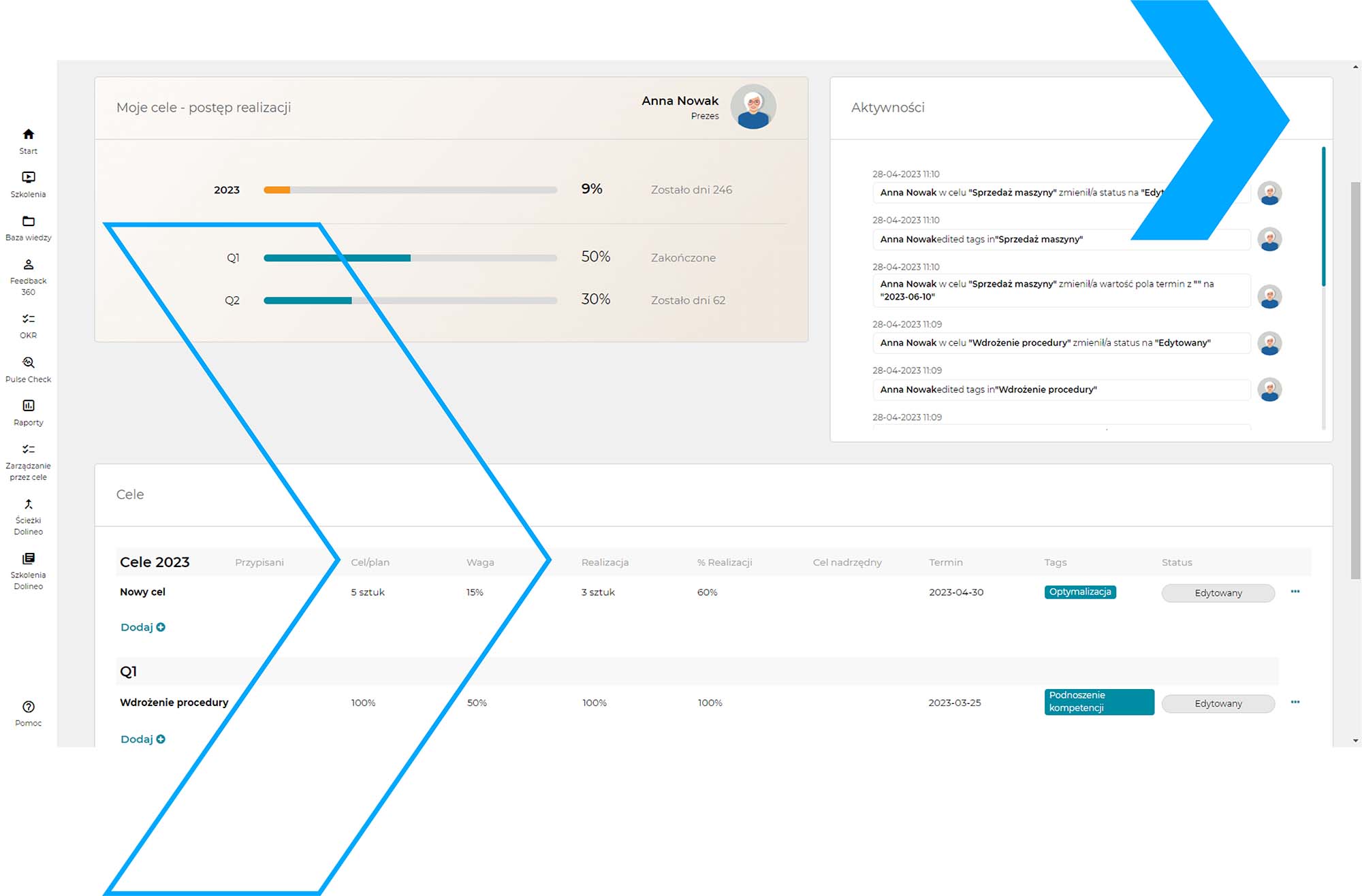
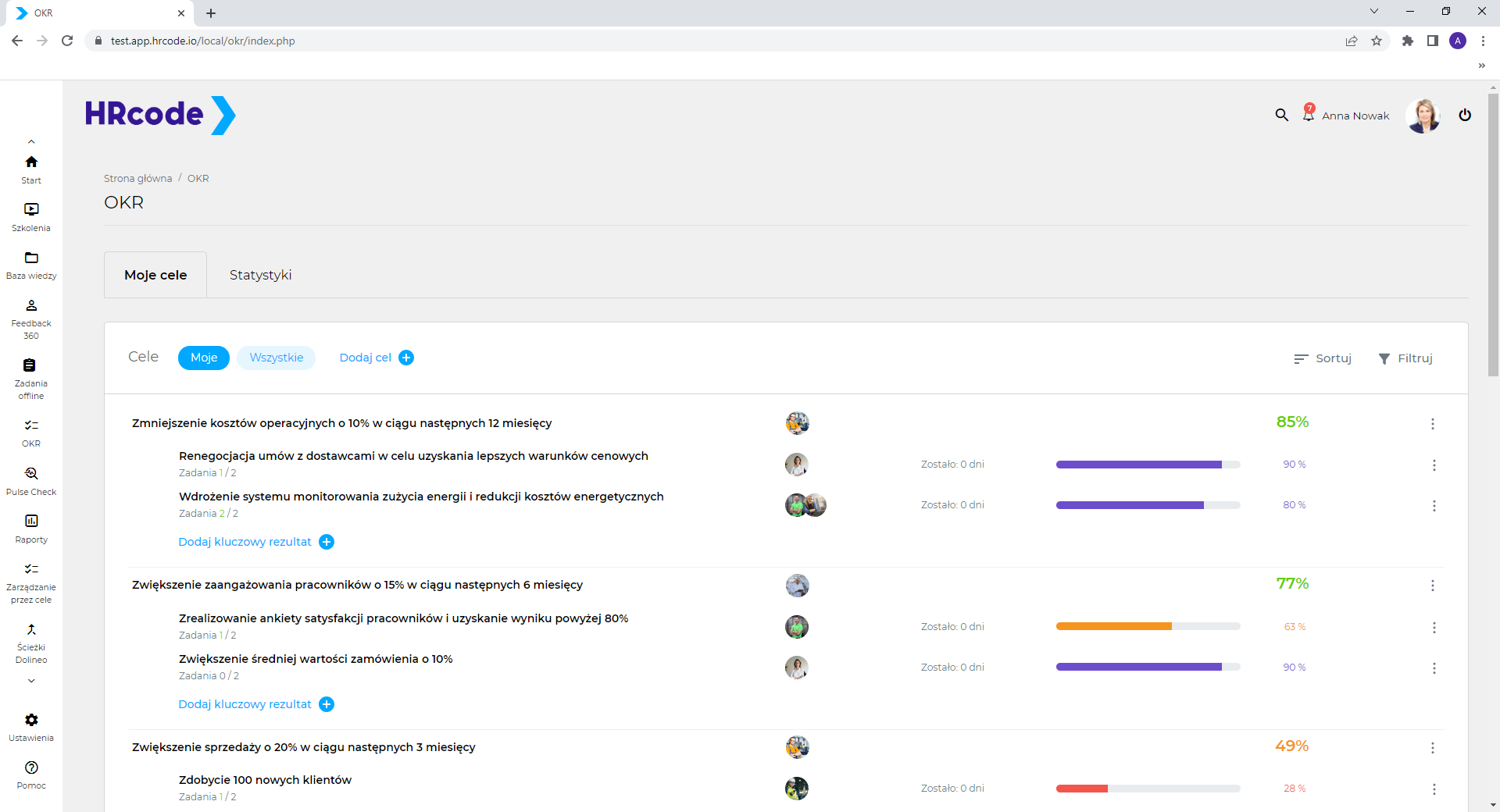
The HRcode platform helps implement the OKR method in organizations. In addition to understanding its main principles, it is extremely important to implement the project, and maintaining OKRs within a single application will be extremely helpful in this regard. The deadline for achieving goals and key results are just as important as the goals themselves. You can do all this in a dedicated application.
But that’s not all – the agility of OKRs lies in regular feedback to determine whether the results that bring the company closer to its goal have been achieved. This can take the form of physical meetings, but reporting and changing the status of results also works very well. Communication in the process is extremely important, so it is also worth giving employees the opportunity to add comments to shared projects so that no status update or important annotation is lost in the flood of emails.
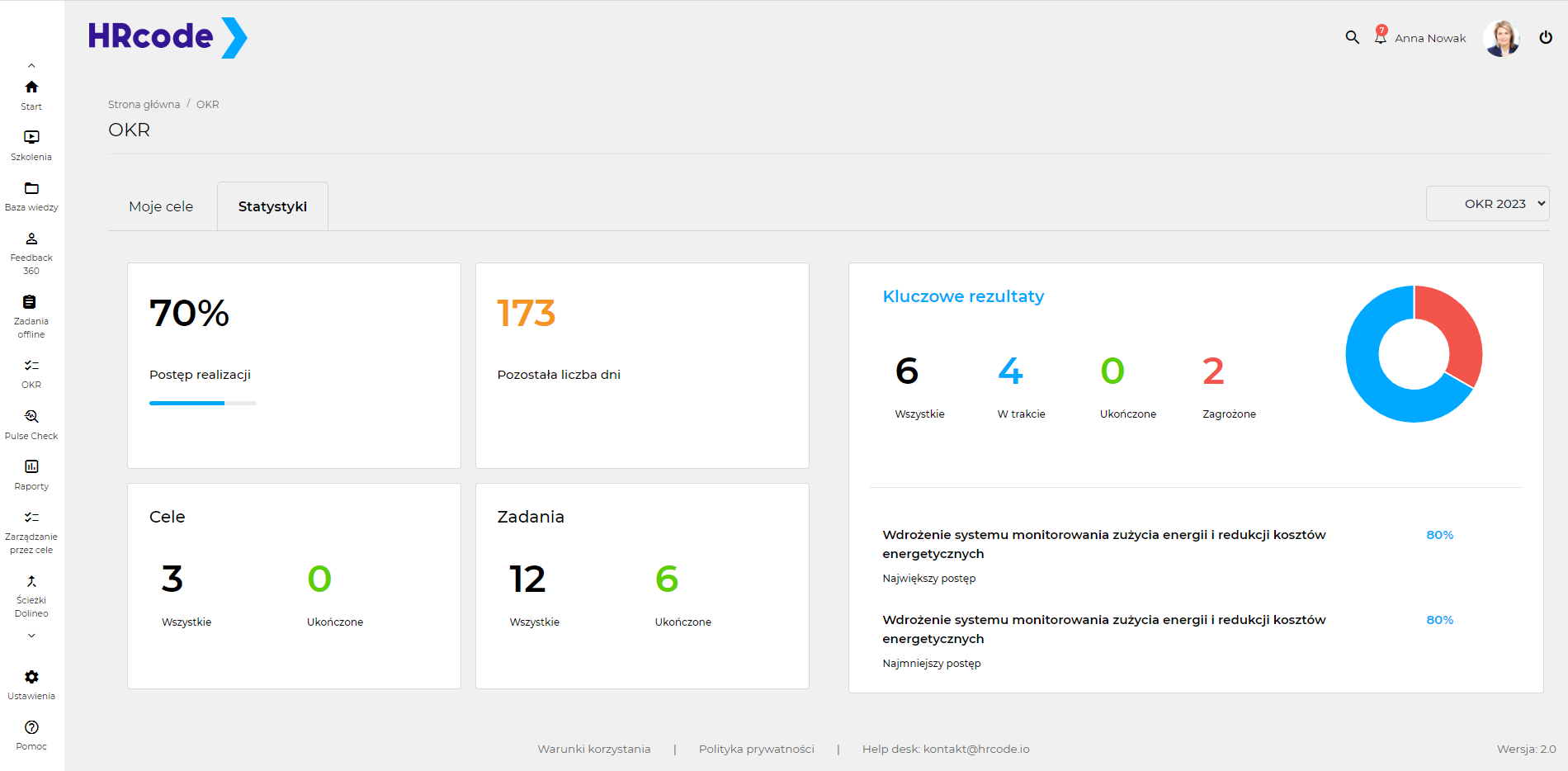
Objectives and Key Results (OKR) – management by objectives system – best practices
Proper communication and education about OKRs will help employees see the many benefits of using this methodology. Active involvement of management has a positive impact on how employees perceive change.
The fact that goals are part of the OKR management system is not the end of the road. Remember to conduct regular reviews, updates, and ensure the transparency of the entire process. This will build confidence that the entire company is working toward a common goal.
Regular feedback on progress will be invaluable (we know we’ve mentioned it before, but it’s really important). You can introduce additional motivational elements, such as rewards or bonuses. Feedback sessions will allow you to provide ongoing support to employees and perhaps also identify new development needs, enabling the organization to achieve its goals faster.
The OKR management method allows you to achieve specific results while maintaining high employee engagement. HRcode can help you implement it smoothly in your company. If you want to learn more about it, check out our blog.
And if you want to learn about other features of the HRcode platform, write to us. We will tell you how we can help you achieve your goals today.
Frequently Asked Questions (FAQ) – OKR
OKR is a management system whose English name is Objectives and Key Results. It is a methodology that helps companies set and achieve goals.
The OKR method originated in the United States. Its principles were developed by Intel and popularized in Silicon Valley by Google. Today, many leading organizations use this method.
The OKR method involves setting goals that are common to the entire organization and then cascading them down to individual departments and employees. The key elements are monitoring results and internal transparency, which allows employees to check at any time how their work translates into company results. OKR is based on short (usually quarterly) sprints, followed by feedback and further task implementation, which is consistent with the agile methodology. A maximum of 2-3 key goals should be set to facilitate task prioritization.
The use of the OKR method brings many benefits. The main advantages include:
- Faster achievement of goals and spectacular results.
- Increased employee motivation and engagement.
- Help in defining strategies and setting priorities for the organization.
- Facilitating the advancement of the company, regardless of the goal set (e.g., recognition, financial goal, brand awareness).
- Simplicity of the method, which has a positive effect on the sense of community, work pace, and creativity.
- The ability to quickly correct actions thanks to short cycles, which prevents moving in the wrong direction for a long time.
- Facilitating task prioritization and saving time, as employees at different levels feel they have an impact and are moving in the same direction.
- Improving information flow and atmosphere in the company thanks to the transparency of the process.
Yes, the OKR method is flexible. If it turns out that the actions are not leading to the achievement of key objectives, it is possible to review the entire strategy or individual elements. This flexibility allows you to overcome challenges and adjust your actions on an ongoing basis.
The introduction of the OKR method can initiate several significant changes in the company’s operations:
- It helps to define the strategy and set priorities, which is helpful both at the beginning of the organization’s journey and during a change in strategy (pivot).
- It allows you to generate engagement and motivation among employees, which contributes to their well-being.
- It enables you to achieve your goals faster and push the company forward.
- It increases the sense of purpose among employees, who can check at any time how their work translates into the company’s results.
Effective OKR definition involves two main elements:
- Objective: It should be qualitative, exciting, inspiring, and easy to remember, appealing to the imagination and motivation of employees. It does not have to be expressed numerically. Examples include creating an expert image, conquering the market, strengthening employer branding, or stabilizing sources of income.
- Key Result: It should be visible and defined using the SMART method:
Specific – the goal is clearly defined.
Measurable – the goal must be measurable (e.g., percentages, specific currency).
Achievable – the goal is ambitious but achievable, and employees have the knowledge and tools to achieve it.
Relevant – the goal is important not only for the organization, but employees also see its value and feel jointly responsible for it.
Time-bound – the goals must be achieved within a specified time frame. It is important that teams also participate in setting goals, taking into account their expectations and experience, which builds commitment.
Employee engagement is key to the success of the OKR method:
- When implemented effectively, OKRs help achieve spectacular results thanks to high employee motivation and engagement.
- Employees have a sense of purpose and see how their work affects results, which increases their engagement.
- Participating in setting OKRs at multiple levels of the organization gives employees a sense of influence and makes them move in the same direction.
- The transparency of the process and the joint setting of OKRs builds a sense of community and trust within the company.
- Regular feedback and support help maintain high levels of motivation and engagement.
Implementing an OKR system is a process that requires several key steps:
- Do your research: Identify areas where OKRs will bring the most benefit and get support from management and key leaders.
- Plan the implementation: Develop a schedule, define resources and responsibilities, and decide which departments will be involved in the first phase. It is a good idea to start by introducing OKR within one department as a trial period.
- Prepare employees: Conduct training and workshops to familiarize them with the method. It is important to provide ongoing support after training, e.g., by appointing OKR ambassadors.
- Develop the first goals and key results: Work with management to define the organization’s strategic goals. Cascade the goals down to the departmental and individual levels, ensuring that each employee understands their contribution. Define specific, measurable key results.
- Implement and monitor progress: Regular progress monitoring and feedback are essential. The process should be transparent, with the ability to report and add comments.
The HRcode platform was created to support companies in the smooth implementation and management of the OKR method. Its functionalities include:
- Implementation of the OKR method in the organization.
- The ability to implement and maintain OKRs within a single dedicated application.
- Support for regular feedback, progress reporting, and status changes.
- The ability to add comments to shared projects, which improves communication.
- A comprehensive HR solution tailored to individual requirements.
- 24/7 availability and mobile device compatibility.
- Supporting employee development and increasing the potential of the entire organization. HRcode is a trusted partner relied upon by large companies in Poland to implement training and educational projects.
Benefits of implementing the HRcode platform

We combine HR requirements with innovative solutions. We tailor the platform to your requirements.

HRcode provides users with 24/7 access, and its appearance adapts to display on mobile devices.

We provide space for dialogue to ensure that the product precisely meets your expectations and development goals.

Check out our case studies

Adam Mickiewicz University – employee evaluation
Adam Mickiewicz University in Poznań currently uses three key HRcode tools that support the development of its employees.



„HRcode is very open to listening to our needs”
“We feel satisfied because people want to use it, and if that’s the case, it means they see the benefits for themselves. The second source of satisfaction is the awareness that we are actually changing this university.”

Klaudia Łęcka
HR Specialist at Adam Mickiewicz University in Poznań
“Full respect to you. Everything is always on time.”
“This is the most important element that we cared about – having a partner, not just a contractor. We immediately hit it off with Mr. Mariusz [Andreasik].”

Grzegorz T. Dokurno
President of the Management Board at AEDMAX.PL
“I am really very pleased.”
“I am really very satisfied. The implementation of HRcode Visits went very quickly – it ‘clicked’ very quickly. Today, it is practically the standard – it’s hard to imagine how it was before.”

Weronika Zdanowicz
Human Resources Manager at Bunge
Why choose HRcode?
A trusted partner for large companies
HRcode is a brand trusted by the largest companies in Poland. We build long-term relationships with our partners, which allows us to enjoy mutual trust when implementing joint projects.