
9 Box Grid, or the nine-field matrix in practice
How to effectively identify talent in an organization? The 9 Grid Matrix, or the so-called nine-box grid, comes to the rescue. It is a type of competency matrix that allows you not only to identify rising stars, but also to take action towards employees at different stages of their life cycle in the organization.
Nine Grid Box is a powerful ally for HR departments, enabling effective and competent team development and, as a result, faster achievement of set goals.
9 Box (nine-field matrix) – what is it?
9 Box Grid for HR is a professional talent management tool. It is used to assess the current performance and development potential of employees. It is a simple but valuable 3×3 grid matrix that helps categorize employees based on two key dimensions: their current performance and growth potential.
The 9-box grid has its roots in the 1970s, when the consulting firm McKinsey created an assessment platform to help General Electric (GE) prioritize investments across all business units. The tool, which later became known as the GE-McKinsey nine-box framework, was inspired by the Boston Consulting Group’s growth share matrix. However, the original structure was slightly different – it compared industry attractiveness with competitive strength to support investment decisions. Subsequently, human resource management experts adapted the matrix for recruitment and selection purposes by adjusting the axis parameters.
- The vertical dimension of the 9 Box matrix assesses the employee’s development potential, divided into three levels: low, medium, and high. These correspond to the employee’s ability to develop and achieve higher positions within the organization.
- The horizontal axis assesses the employee’s current performance, also divided into three categories: below expectations, in line with expectations, and exceeding expectations.
Combining these two dimensions gives nine fields that allow managers to place employees in appropriate areas, ranging from “low performance and low potential” to “high performance and high potential.” This method makes it possible to identify employees who may be candidates for promotion but need additional development (high potential), as well as those who are best let go.
The 9 Box Grid is particularly useful in succession planning, helping to identify potential leaders and develop career paths. This tool is valued for its simplicity and versatility. It offers a clear and understandable way to visualize talent within an organization. However, like any tool, it requires proper use and clear criteria to avoid a lack of objectivity. Even the best-prepared tool can be influenced by the human factor.
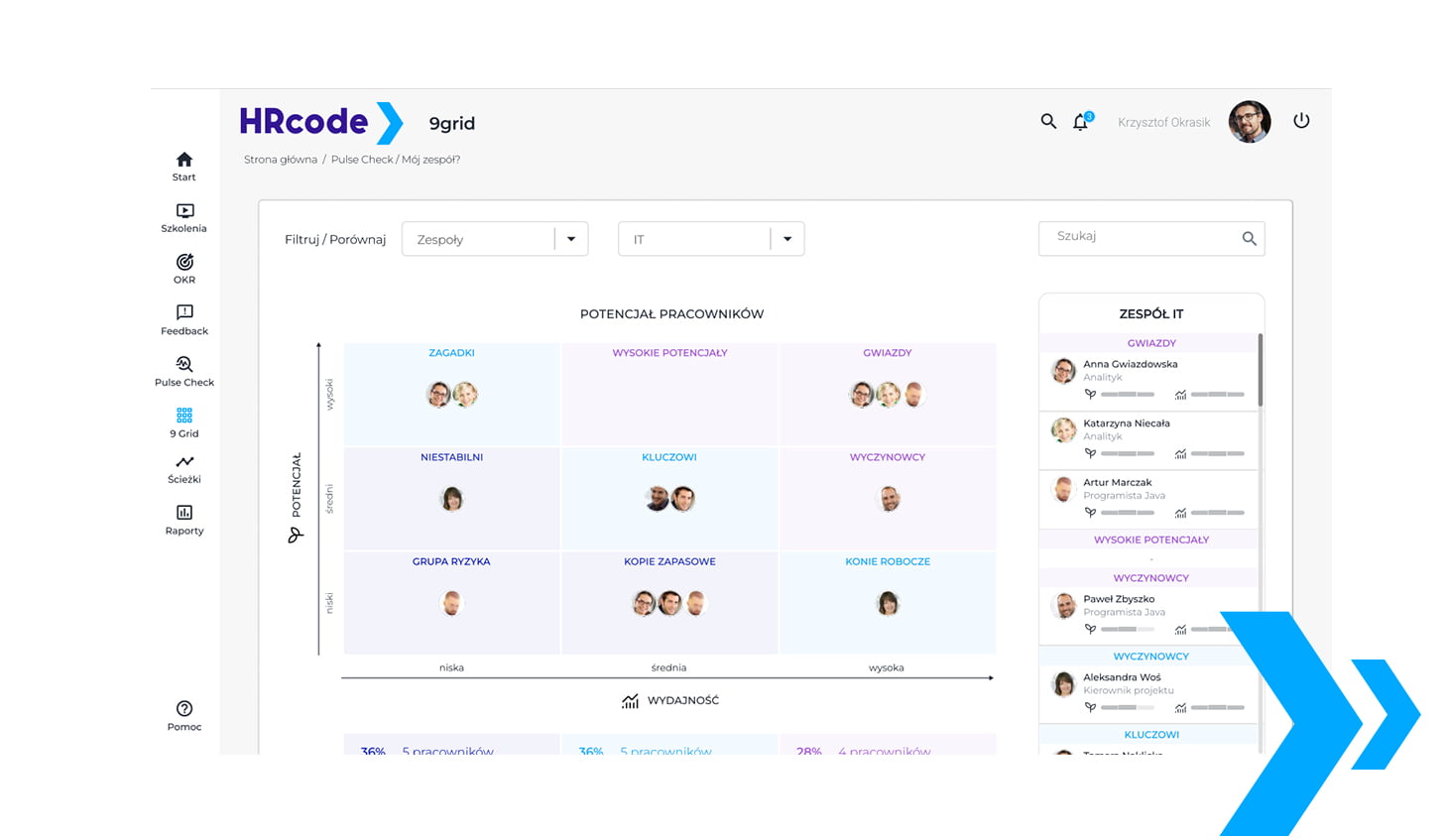
Why use 9 Box Grid?
Using the 9 Box Talent Matrix has several significant advantages that make this tool attractive to L&D managers in organizations:
- Simple visualization – The 9 Box Grid presents employee performance and potential in an easy-to-understand way. Thanks to a simple 3×3 grid, managers can quickly identify where their employees stand in terms of current performance and potential for development.
- Support in career path planning – the matrix helps identify high-potential employees who may be candidates for future leadership roles. This enables optimal planning of their training and support for the development of the necessary competencies.
- Strengthening motivation – the tool can help increase the motivation and commitment of employees who see that their development is appreciated and supported by the organization.
- Facilitating the evaluation process – the 9 Box matrix makes it easier for managers to make more objective evaluations of employees, taking into account both their current performance and potential.
Using the 9 Box Grid requires a careful approach to ensure that personal likes (or dislikes) do not influence objective assessment. It is important to use this tool in a balanced way and to supplement it with other employee evaluation methods.
How does the 9 Box Grid work?
The 9 Box Grid is created by evaluating employees on two key axes: performance and potential. The entire process consists of several steps:
- Performance evaluation – employees are evaluated based on their current productivity. Evaluation criteria may include quality of work, achievement of goals, ability to cooperate, and other indicators relevant to the company.
- Potential assessment – the second dimension is the assessment of an employee’s potential for competence development. This assessment takes into account the ability to cope with challenges, proficiency in acquiring new skills, and the opportunity for future promotion.
- Mapping – after assessing an employee’s performance and potential, their name is placed in the appropriate field on the 9 Box matrix. It consists of nine fields, created by the intersection of three levels of performance with three levels of potential. Each field represents a unique combination of performance and potential, ranging from “low performance and low potential” to “high performance and high potential.”
- Action planning – based on the position of employees in the matrix, managers can plan appropriate actions, such as training, development programs, promotion paths, or even a change of role, if necessary.
- Development and monitoring – once action plans have been implemented, it is important to monitor employee progress and organizational needs, and to regularly update positions in the matrix.
9 Box Grid is particularly useful in processes such as succession planning, leadership identification, performance management, and employee development. In large organizations, the process is usually managed by an employee development specialist (L&D manager).

How to effectively implement the 9-box?
How to effectively implement the 9 Box Grid in your company? It is crucial that all parties involved, including the HR team and managers, have a good understanding of how the 9 Box Grid works and what its objectives are.
Before beginning the employee evaluation, clearly define the criteria for both axes of the matrix – performance and potential. This is important to ensure consistency and objectivity in the evaluation. These criteria should be tailored to the specifics of the company and its organizational culture.
Supervisors are key figures in the assessment process, so they must be well prepared to use the tool properly. They should know:
- how to evaluate employees,
- how to conduct constructive conversations about development.
- how to use the matrix for succession planning and talent development.
They assess the members of their teams, placing them in the appropriate fields of the 9 Box matrix. The evaluation should be based on data, not just subjective feelings.
Based on the assessment results, managers and the HR team should develop individual development paths for employees, taking into account their position in the matrix. Such a plan may include training, new tasks, and development projects.
The 9-box grid is not a static tool. Regular reviews and updates of employee positions in the matrix are crucial to reflect their development and changes in the organization.
Effective implementation of the 9 Box Grid in an organization requires a thoughtful approach that takes into account both the needs of the organization and the individual characteristics of employees. For the technical side of the project, it is worth inviting an experienced service provider to collaborate, such as HRcode.
9 Box Grid is an extremely valuable tool that can bring significant benefits to your company in terms of identifying, developing, and effectively utilizing talent. Proper implementation and use of this matrix can significantly impact your human resource management strategy.
However, like any tool, the 9 Box Grid requires the right approach and experience to fully exploit its potential. Therefore, if you are looking for professional support in implementing the 9 Box Grid in your organization, we encourage you to contact HRcode. As an experienced HR software provider, we will provide you with comprehensive assistance in adapting the 9 Box Grid to the specifics and needs of your company, ensuring that you maximize the benefits of this tool.
Contact us to learn more about how we can support your team’s development and help your organization achieve its strategic goals. Together, we can build a stronger, more engaged, and more effective workforce that will be the driving force behind your business. We invite you to work with HRcode – your partner in talent management.
Bibliography:
https://www.mckinsey.com/capabilities/strategy-and-corporate-finance/our-insights/enduring-ideas-the-ge-and-mckinsey-nine-box-matrix;
https://www.tmi.org/blogs/talent-management-and-the-9-box-grid-what-you-must-know;
https://www.shrm.org/topics-tools/tools/hr-answers/succession-planning-9-box-grid.

Małgorzata Turowska
Gosia has a scientific mind and feels at home in the world of processes, structures, and systemic solutions. With her technological approach and HR flair, she designs solutions that allow companies to say goodbye to the chaos of spreadsheets and take their competence management to the next level.
At HRcode, she is responsible for creating and developing tools that truly support HR departments, regardless of the size of the organization.
On her blog, she shares her knowledge on how to organize HR processes, implement changes step by step, and convince organizations that digitization pays off. Always to the point, without beating around the bush.