
E-learning platform – a modern tool for employee development
Employee development is one of the key aspects of company management, and e-learning platforms are becoming an increasingly important tool in this area. You may ask: how can you create a learning environment that will ensure your team’s education? The answer lies in modern technologies and a well-planned training path.
An e-learning platform is a system that provides access to online educational materials, allowing employees to acquire new skills and develop professionally in line with the company’s needs. E-learning is not only a convenient but also an effective way of learning that can be tailored to the individual needs of each person in the organization.
The e-learning platform is revolutionizing training processes in companies. It provides access to online educational materials anywhere and anytime, which in itself is an innovative approach to development. It also contributes to increasing the efficiency and competitiveness of organizations, which is not without significance in today’s labor market.
What is e-learning?
E-learning means online learning. Today, it is an integral part of business that has revolutionized training processes. However, before we look at contemporary solutions, it is worth going back in time and exploring the history of e-learning.
The beginnings of distance learning using information technology date back to the 1950s and 1960s. The first systems were very primitive and based mainly on the use of text and graphics.
Prototypes of e-learning systems date back to the 1970s and 1980s. However, it was not until the development of the Internet and digital technologies in the 1990s that a real revolution in e-learning took place. Thanks to global access to the Internet, it became possible to deliver educational content online, which significantly increased the accessibility of learning.
With the development of technology, e-learning platforms have become increasingly advanced, enabling interactive learning, the use of multimedia, and the tracking of learners’ progress. E-learning is no longer just a tool for acquiring theoretical knowledge, but has become an interactive educational experience.
Currently, companies use e-learning to train employees, manage competencies, and provide information and procedures. Thanks to e-learning, employees can acquire new skills, improve their qualifications, and adapt to changing market requirements.
E-learning – a corporate must-have
A survey conducted by the LinkedIn professional network shows that 64% of learning and development (L&D) experts perceive educational activities in companies as a mandatory “need to have” element. This transformation has been accelerated largely by the COVID-19 pandemic, which has made digital learning the norm. Research confirms that modern development tools are very effective in preparing employees to cope with change.
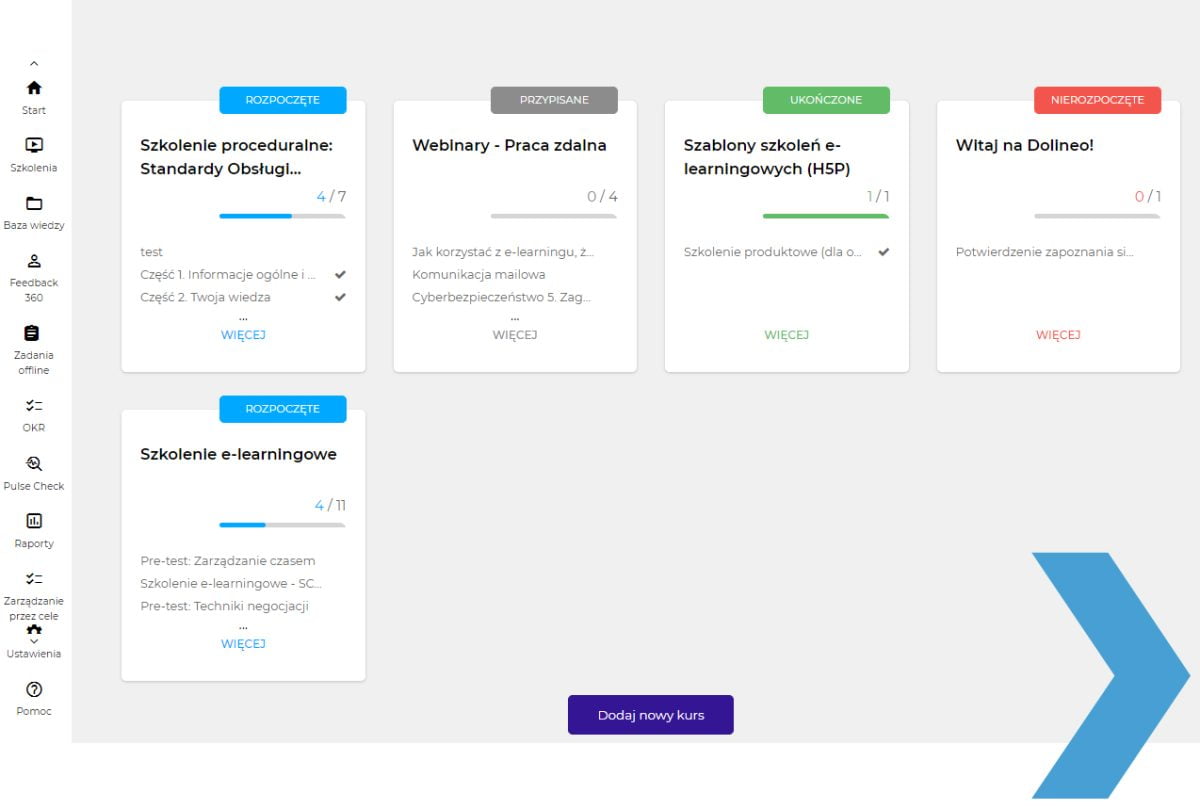
Modern e-learning platforms, such as those offered by HRcode, provide advanced tools for online learning. Dedicated content, interactive courses, reporting systems, and the ability to customize the platform to the individual needs of companies are the foundation of e-learning success in business. These tools not only increase the effectiveness of the learning process, but also contribute to the development of employee competencies and the growth of the organization’s competitiveness in the market.
E-learning in business
Modern technologies enable the use of forms of education that work perfectly in a business environment. E-learning allows teams to acquire new skills and knowledge at a pace and in a place that suits them (and their employer). It is a way to effectively combat employee turnover by offering them attractive development opportunities.
E-learning has become an integral part of the development strategy in many companies. It is gaining popularity not only because of the benefits it brings to employees, but also because of the time and cost savings it offers. Companies can provide training and educational materials online, eliminating the need for traditional classroom training.
However, in order to fully exploit the potential of remote learning, it is necessary to have a suitable e-learning platform. Designing such a tool is a key stage that has a significant impact on the effectiveness of the learning process.
The training process from A to Z
A digital educational platform, also known as a learning management system (LMS), not only allows you to collect teaching resources, but also to administer courses and their participants.
The fundamental functionality of such a solution is the ability to manage user profiles. Thanks to LMS, you can supervise the entire educational path – from registering users and assigning them to appropriate training courses, to monitoring their progress and automatically issuing certificates.
Complex e-learning systems often integrate additional components, including:
- notifications,
- tools for conducting surveys and exams,
- a module for creating your own training programs,
- webinar sessions,
- gamification elements.
Only a system tailored to your needs can become a fully-fledged knowledge management tool within your organization.
E-learning platforms provide flexibility in learning, allowing employees to tailor their learning time to their schedule. This is especially important at a time when remote working and asynchronous working hours are becoming increasingly popular.
The last decade has seen a marked increase in interest in the online education sector and related technologies. This trend is not surprising, given that digital learning methods are transforming the way skills are acquired, making it more dynamic, easily accessible, and tailored to the unique needs of both The availability of knowledge on demand, regardless of place and time, perfectly corresponds to the concept of continuous learning and educational autonomy, promoting the idea of lifelong learning.
The development of digital and internet technologies opens up new perspectives for organizations and individuals in terms of personalizing training paths. Such flexibility allows for better adaptation to changing market conditions. Digital educational tools support professional and personal development, making the learning process more interactive and engaging, which is in line with the modern expectations of both employees and employers.
The most important objectives of the e-learning platform are:
- supporting employee development,
- increasing their skills,
- providing tools for effective career development.
This tool not only allows you to acquire new skills, but also enables you to monitor your progress and evaluate the effectiveness of the learning process.

How to choose the best e-learning platform?
In today’s digital world, choosing the best e-learning platform is one of the challenges for companies that want to effectively develop their employees. E-learning is not only convenient, but also a necessity in order to keep up with the dynamic changes in the business environment. It is therefore worth considering what to look for in order to make the right choice.
It is clear that selecting the right platform to support employee development within a large company is a complex and demanding process. With so many systems available on the market, organizations considering implementing such software are faced with numerous choices:
- Which functions should they focus on?
- What solutions will prove effective for their structure?
- Which sectors of the company are most in need of digital support?
- How to identify and select the best supplier?
When choosing an e-learning platform for your company, it is worth paying attention to several important elements. Here are some issues to consider:
Features
The best e-learning platform for businesses should offer a wide range of functionalities. Access to a variety of educational materials, tools for tracking progress, and the ability to create your own courses are just some of the features worth considering.
The system should be intuitive, offer a variety of tools for creating and managing courses, and allow for integration with other systems. The main task of an e-learning platform is to systematize and provide employees with the right courses. Many platforms also offer training paths or education programs, the most popular of which is onboarding.
What should you pay attention to?
A dedicated e-learning platform allows for full adaptation to the specific nature of the company’s operations and development goals, and also enables the implementation of various training paths for employees.
Implementation
The process of implementing an e-learning platform can be complicated, so it is worth paying attention to the support offered by the provider. Check whether the company offers training for staff and assistance in adapting the platform to the needs of your business.
What should you pay attention to?
Implementing an e-learning platform in a company is not just a technical issue. You also need to consider what training materials will be available to employees, what development paths will be offered, and how the onboarding process will work. The key to success is a well-thought-out design of the e-learning platform and its integration with other systems in the company.
Integrations
The e-learning platform should be integrated with other company systems, such as the personnel management system or data analysis tools. This allows you to effectively monitor employee progress and measure the effectiveness of the learning process.
What should you pay attention to?
Consider what kind of integration you want. Should the platform connect to an HR, CRM, or other system?
Costs
The final choice may depend on the budget allocated for the implementation and maintenance of the platform.
E-learning platform from HRcode
One of the e-learning platforms that meets the above criteria is HRcode. It is a comprehensive solution that enables effective management of the learning process in a company. It allows you to create and deliver a variety of educational materials, monitor employee progress, and analyze training results—just as you need it. The advantages of our system include:
- Integrations – the ability to integrate with other systems makes HRcode the central point for all employee development activities.
- Comprehensive approach – the HRcode platform combines the functions of a training management system with internal communication tools.
- Dedicated training paths – thanks to the HRcode platform, you can create individual development paths for employees in different positions.
- Process automation – the platform allows you to automate many processes, such as onboarding and initial training.
Creating an e-learning platform – a solution tailored to our times
If your company has unique requirements, creating your own e-learning platform is the best idea. It will allow you to tailor the online learning system directly to the specific needs of your employees.
The COVID-19 pandemic has forced us to change the way we live and work. Many activities, including learning, have moved online. Remote lessons have become the new norm, using e-learning platforms that have been around for a long time but have suddenly gained popularity. Trainers and teachers, as well as trainees and students, have had to quickly learn new digital tools.
As a result, the digitization of education has become a reality overnight, and e-learning has developed on an unprecedented scale, leaving no room for a return to old teaching methods. Why not take advantage of this in your organization as well?
An e-learning platform is an integral part of employee development in modern companies. Choosing a solution tailored to the needs of a specific organization is extremely important, so it is worth paying attention to:
- functionality,
- customization,
- implementation,
- possible integrations.
The HRcode platform is one of the solutions that meets these criteria. We will provide you with a ready-made solution or design a tool tailored to the needs of your organization. This allows your company to effectively develop the competencies of its team, which translates into success in today’s competitive business environment.
Chcesz dowiedzieć się więcej? Write to us, we will be happy to tell you how we can help you grow!
Bibliography:
https://elearningindustry.com/top-elearning-trends-look-out-for-2022;
https://www.theguardian.com/education/2021/jan/23/after-covid-will-digital-learning-be-the-new-normal;
https://www.behance.net/blog/never-stop-learning-how-self-education-creates-a-bullet-proof-career.

Mariusz Andreasik
Mariusz knows HR from the business side, from clients, and from everyday conversations that lead to real change in organizations. He listens to companies' needs and shows them that HRcode can do more: implement faster, manage better, and develop people more effectively.
He is the originator of many solutions in the HRcode system, and his sales experience translates into a practical approach to technology.
On his blog, he shares inspirations, trends, and examples of implementations that show that automated, modern HR is not the future—it is the present.